


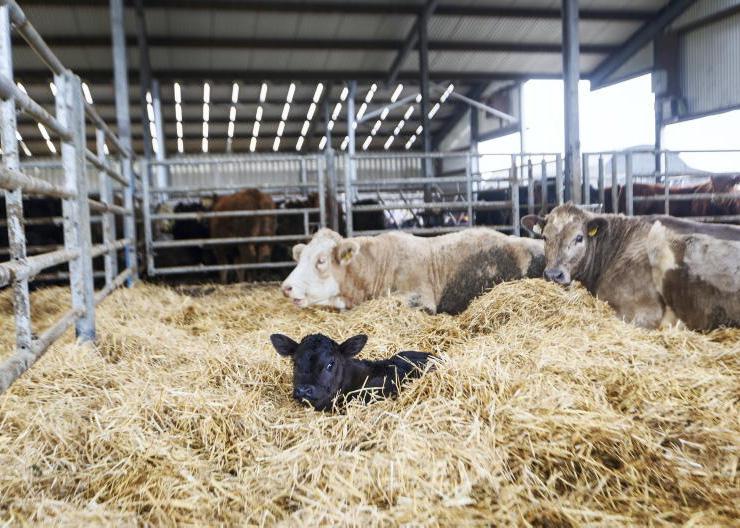
Calving 2026 has kicked off on the farm and continues to progress well with 19 cows/heifers now calved. The majority of calvings at the start of the season are made up of first calved heifers, with 12 of the 19 calvings coming from heifers who were synchronised last April and are predominantly in calf to sexed female semen.
The breakdown is currently made up of 75% (15) female calves vs 25% (4) male calves born.
As most readers will know Tullamore Farm uses 100% AI and has focused on the use of sexed semen over the past two breeding seasons.
Sexed semen is used to focus on the production of females to sell as in-calf heifers.
The use of AI has given the farm freedom in flexibility with bull selection. We purchase our own straws, stored in our own flask which gives us the option of using multiple bulls from multiple AI stations based on the traits we desire.
A total of 14 bulls were used in 2025 with some bulls used only on heifers while others were used on mature cows. Tables 1 and 2 gives a breakdown on the breeding strategy used on cows and heifers
The wide range of bulls used are selected mainly on traits that are matched to certain cows within the herd.
We focus mainly on maternal traits for the production of females especially where sexed semen is being used, conventional bulls used tend to have quite balanced figures for replacement/terminal traits meaning that the male calves born will have adequate growth rates and conformation for either finishing or live sale.
The female calves born from the conventional semen used, when matched with high maternal index cows will still come in as four and five star on replacement index to satisfy SCEP.
Calving ease also plays an important role in bulls selected especially for sires used on first calving heifers.
Preparations for calving in spring of 2026 realistically began on the first day of breeding 2025 with bull selection, as outlined above, having a major influence on how the calving season materialises.
Outside of breeding decisions, after weaning, cows would have been penned according to body condition score (BCS) and fed accordingly to either maintain body condition or build to BCS 3-3.25 by Christmas.
The majority of cows were weaned off in an ideal condition score of 3-3.25 so a maintenance diet was adequate for the majority of winter. A small number of cows, typically those who may have reared twins or first calvers who weaned in poorer condition were penned together and offered the best-quality silage to increase condition pre calving.
In the early days of January cows were administered a scour vaccine and penned up according to calving date.
Pre-calver minerals were introduced also at this point at a rate of 130g/head/day and have been built up to 160g at the point of calving.
The farm has had issues in the past with slow calvings associated with a lack of calcium at calving, determined by blood tests carried out by farm vet Donal Lynch who then advised a higher supplementation rate of 160g of pre calver minerals to counteract these issues.
A compact calving season means that it is important to get preparation right, sheds and calving pens where young calves will be born were power washed and disinfected thoroughly before cows started calving to reduce the risk of disease or scour.
Cows are taken off slats approximately four-five days pre-calving and given access to sawdust/straw bedding.
This helps to dry up udders and hides pre-calving, reducing the risk of calves ingesting bacteria as they try to suckle their mothers initially.
Colostrum management is a key element of a successful calving season. On Tullamore Farm the general rule is that all assisted calvings are stomach tubed with two/three litres of colostrum from the cow immediately after birth and a store of frozen colostrum is available should a cow prove difficult to milk or if quantity is poor.
Cows that calf unassisted generally remain unassisted in all areas with these calves generally being vigorous and able to suckle unaided.
All calves are treated with a naval treatment (Iodine/Chlorohexidine) soon after birth, provided it is safe to do so.
Expected calving dates on ICBF show that Tullamore Farm should achieve a six week calving rate between 75-80%, with 50% of the herd calving in the first four weeks.
Calving activity is expected to ramp up over the next few days but given the higher than average rainfall in January and more rain forecasted this week it is unlikely any cows/calves will be turned out to grass anytime soon.
This will put extra pressure on housing space and close attention will have to be paid to keeping clean beds under young calves. However straw and fodder supplies are plentiful so this should not be an issue until turnout is possible.
Slurry stores are also starting to fill up so a spell of dry weather will most certainly be welcome to reduce pressure. We were able to travel five acres of dry ground last week to relieve pressure on storage.
No fertiliser has been spread to date, Five tonne of protected urea has been purchased at the price of €580/tonne and will be spread at the rate of 30kg/acre as soon as conditions allow .


SHARING OPTIONS